
You spent three hours perfecting your resume—tweaking the wording, adjusting the format, making sure every keyword was in place.
The recruiter spent six seconds on it.
And then? Nothing. No callback. No interview. Just silence.
So you told yourself: “My resume isn’t good enough.” You revised it again. Maybe you even asked ChatGPT to polish it. Same result.
I’ve seen this cycle play out countless times. But here’s what I’ve started to wonder: what if the problem isn’t how you write your resume?
The Two Types of Resume Gaps
After looking at hundreds of resumes, I noticed something interesting.
There are actually two different types of gaps between your resume and a job posting. Most people confuse these two—and end up solving the wrong problem.
Presentation Gap: You have it, but didn’t show it well
You have the skill, but your resume doesn’t communicate it clearly.
For example, say you’re a Project Manager. You’ve led cross-functional projects before, but your resume just says “tracked project progress and coordinated with team members.” That’s too vague—it could describe an intern.
Now imagine this instead: “Led 5 cross-functional projects using Jira, coordinating teams across Taiwan, US, and India. Improved on-time delivery rate from 70% to 95%.”
Same experience. Completely different impact.
This is where AI writing tools actually help. They’re good at turning vague descriptions into specific, powerful statements.
Skill Gap: You simply don’t have it
You don’t have the skill at all.
The Data Scientist role requires hands-on experience deploying ML models to production—you’ve only done Jupyter notebooks. The PM position needs someone certified in Agile/Scrum with experience in Monte Carlo simulation for project forecasting—you’ve never used those tools.
In this case, no amount of resume polishing will help.
Because what you’re missing isn’t better words. It’s the skill itself.
Why Most Resume Tools Don’t Work
Here’s the problem.
Most resume tools out there—including asking ChatGPT to rewrite your bullet points—only address the first type of gap. They help you polish sentences, optimize keywords, and format for ATS systems. All useful, but they only solve half the problem.
What about your Skill Gaps? Nobody tells you.
So you send out 50 applications and get 2 responses. You assume your writing isn’t good enough. You keep revising and reapplying.
But the real issue might be: you don’t actually qualify for 80% of those jobs.
You’ve been polishing the appearance of a key that doesn’t even fit the lock.
The Right Approach: Diagnose First, Then Act
This made me think about a more fundamental question: what’s the right order for job searching?
The traditional approach looks like this:
Write resume → Apply → Wait → Get rejected → Revise → Repeat
The biggest problem with this process? You never know what went wrong. Was it your writing? Or your skills? You can only guess.
But what if you flipped the order?
Diagnose gaps → Understand what’s missing → Decide whether to apply → Prepare strategically
Before you apply, you already know your chances with this job. You know which skills you have and which you’re missing. And for the ones you’re missing, you know how to build them.
This way, you don’t blindly send 50 applications wondering why nobody responds. You see the situation clearly first, then decide how to move forward.
How to Diagnose Your Resume
This is exactly why we built AI Resume Advisor.
We don’t just help you rewrite. We help you diagnose.
Step 1: See your match score instantly
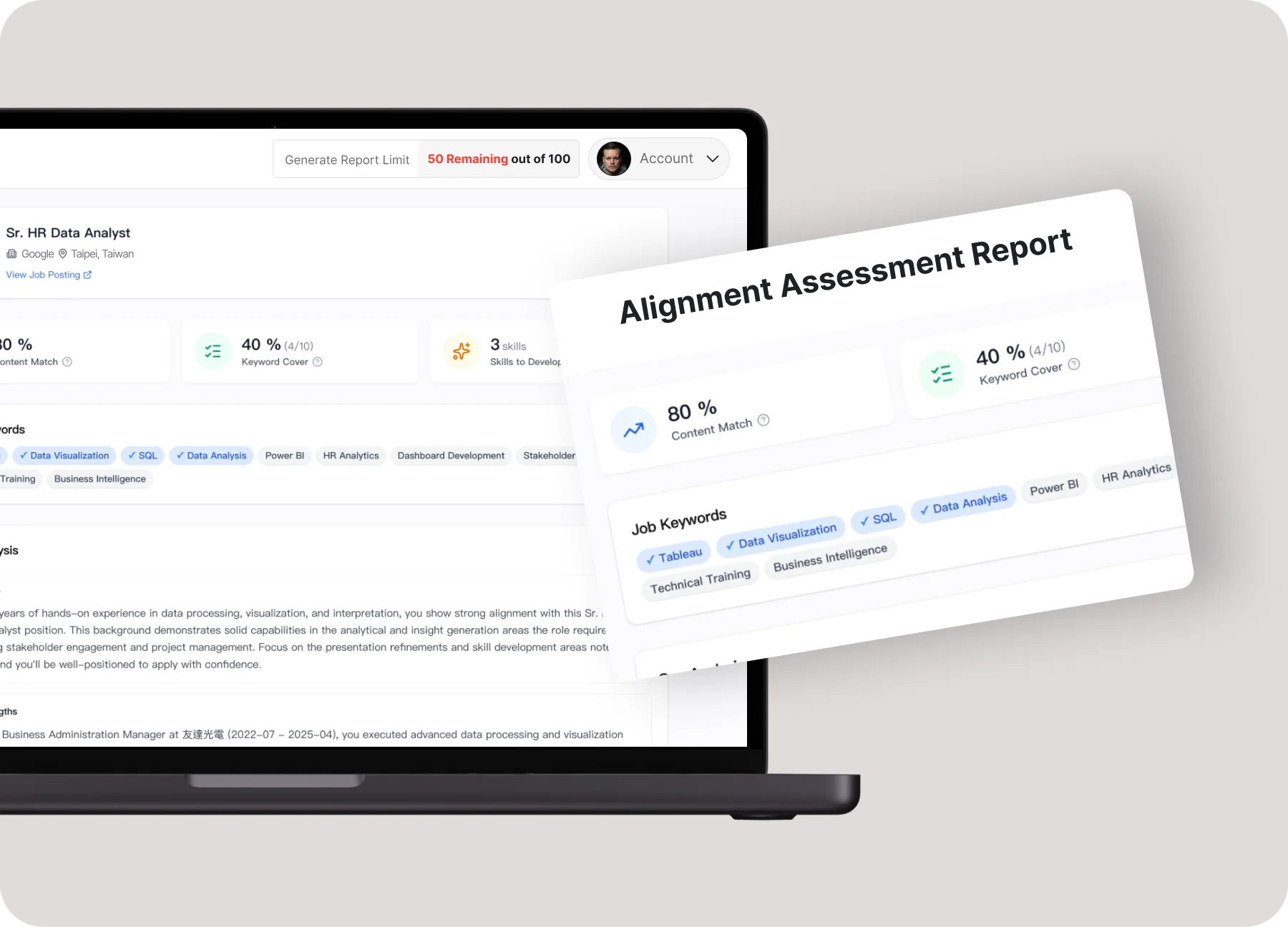
When you browse jobs on LinkedIn, our browser extension shows your match score in 3 seconds. No guessing—the numbers tell you directly.
Step 2: Understand both types of gaps
Click through to the full report (takes about 30 seconds), and you’ll see both gaps clearly separated:
- Presentation Gap: You have the skill but didn’t showcase it well → AI rewrites it for you
- Skill Gap: You’re actually missing this skill → We recommend specific courses to close the gap
Step 3: Build skills, not just better sentences
For your Skill Gaps, we recommend courses from Google, IBM, Meta, and top universities.
Think of it like a skill tree in a video game. You can see where you are now, where you want to be, and which skills you need to unlock along the way. Except this time, it’s for your real career.
Related: Best LinkedIn Chrome Extensions for Job Seekers (2026)
Conclusion
I’m not sure this applies to everyone.
But if you’ve revised your resume many times and still aren’t seeing results, maybe it’s worth looking at it differently:
The problem might not be your writing. It might be your diagnosis.
Figure out what you’re actually missing first. Then decide how to fix it. That order matters more than you might think.
Start Diagnosing Your Resume
Want to know the real gap between you and your target job?
See your match score in 3 seconds. Get your full diagnosis report in 30 seconds.