
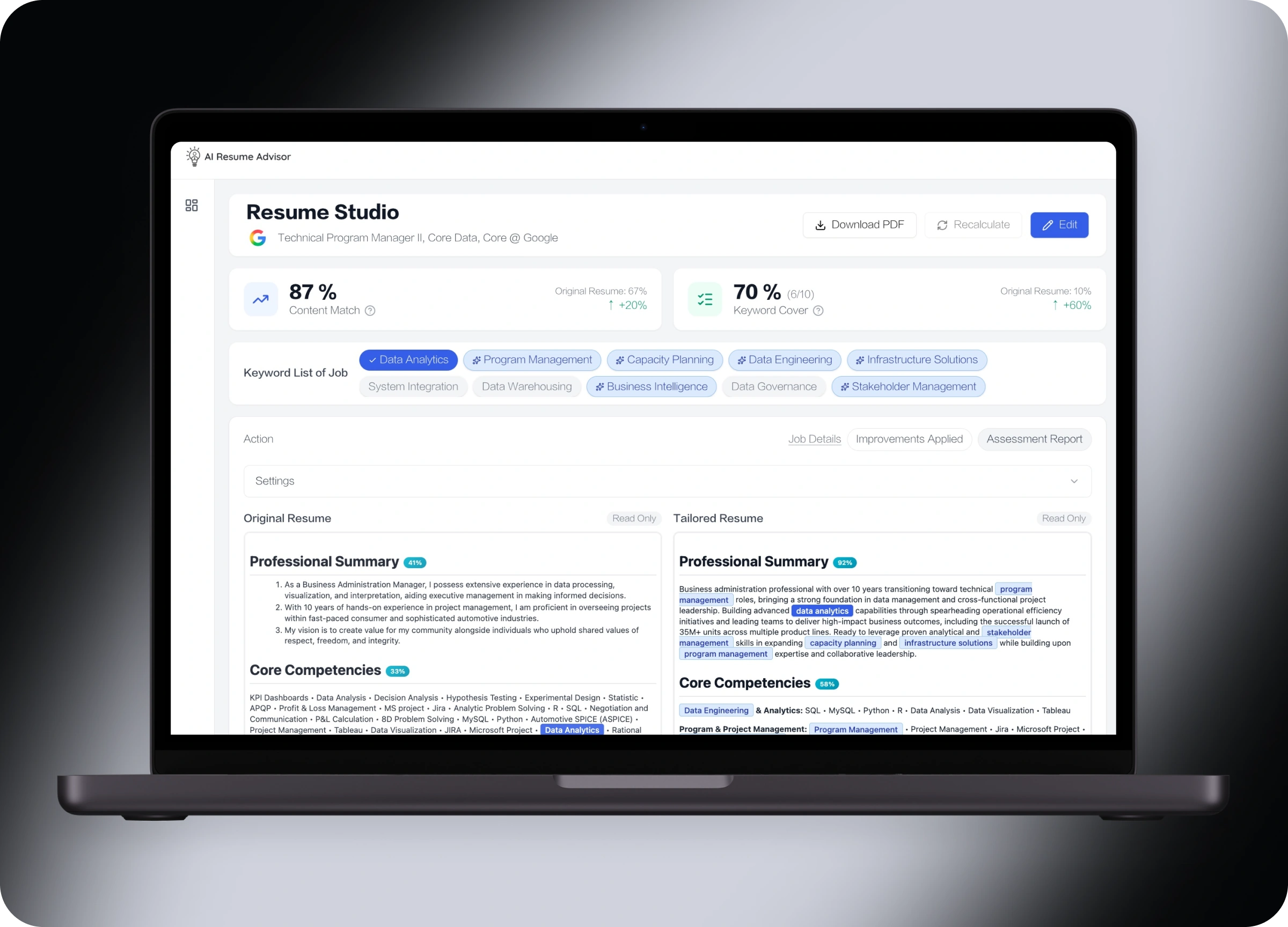
How to Tailor Your Resume to a Job Description: 3 Steps to 6X More Interviews
Sending out dozens of resumes but hearing nothing back?
The problem might not be your experience—it’s that your resume isn’t aligned with what the job actually needs.
According to industry data, tailored resumes are 6 times more likely to land interviews than generic ones. If your resume title matches the job title exactly, that number jumps to 10.6 times.
This guide will teach you a simple 3-step method to tailor your resume quickly and dramatically increase your interview chances.
Why Tailoring Your Resume Matters
The ATS Reality
Over 99% of companies now use ATS (Applicant Tracking Systems) to screen resumes.
What does this mean? Your resume gets scanned by software before any human sees it.
According to recruiter surveys:
- 76.4% filter by skills
- 55.3% filter by job title
- 50.6% filter by certifications
If your resume doesn’t include the keywords from the job description, it may get filtered out—no matter how qualified you are.
Tailored vs Generic Resume
| Generic Resume | Tailored Resume | |
|---|---|---|
| Prep Time | One and done | Requires adjustment each time |
| ATS Pass Rate | Low | High |
| Interview Chances | 1x | 6x |
| Recruiter Impression | ”Another copy-paste resume" | "This person did their homework” |
The 3-Step Tailoring Method
Step 1: Extract Keywords
First, read the job description carefully and highlight the keywords.
Types of keywords to look for:
| Type | Examples | Weight |
|---|---|---|
| Hard Skills | Python, Excel, Google Analytics | High |
| Soft Skills | Teamwork, Communication, Problem-solving | Medium |
| Job Title | Product Manager, Data Analyst | High |
| Certifications | PMP, MBA, AWS Certified | Medium |
How to judge keyword importance:
- Appears 2+ times = Very important
- Listed in top 3 requirements = Priority
- Marked as Required vs Preferred
Practical Example
Let’s say the job description reads:
We’re looking for a Data Analyst responsible for:
- Processing data using SQL and Python
- Creating data reports to support business decisions
- Collaborating with cross-functional teams to communicate insights
Requirements:
- 2+ years of data analysis experience
- Proficiency in Excel and data visualization tools
Extracted keywords:
- Job Title: Data Analyst
- Hard Skills: SQL, Python, Excel, Data Visualization
- Soft Skills: Cross-functional collaboration, Communication
- Experience: 2+ years
Step 2: Match & Rewrite
Take your resume and “translate” your experience into the job’s language.
Before/After Example
Job Requirement: Process data using SQL and Python
❌ Before (Generic)
Handled internal data management tasks
Problems with this:
- No specific tools mentioned (SQL, Python)
- No quantified results
- ATS can’t detect relevant keywords
✅ After (Tailored)
Processed 500K+ monthly transactions using SQL and Python, built automated reporting pipelines, reducing report generation time from 3 days to 4 hours
Why this works:
- ✅ Includes keywords (SQL, Python)
- ✅ Has specific numbers (500K, 3 days → 4 hours)
- ✅ Shows impact (automation, efficiency gains)
Use PAR / CAR / STAR to Provide Evidence
Key Principle: Every keyword needs evidence to back it up. Listing skills isn’t enough—you need to prove you’ve actually used them.
Common frameworks:
| Framework | Structure | Best For |
|---|---|---|
| PAR | Problem → Action → Result | Problem-solving experiences |
| CAR | Challenge → Action → Result | Overcoming challenges |
| STAR | Situation → Task → Action → Result | Complete scenario descriptions |
Simplified Formula:
Action Verb + What You Did + Result Achieved
| Element | Description | Example |
|---|---|---|
| Action Verb | Start with a strong verb | Built, Optimized, Led, Developed |
| What You Did | Specific work (include keywords) | Built data analysis pipeline using Python |
| Result | Quantified outcome | Improved efficiency by 40% |
Complete Example:
Optimized database query logic (SQL), reducing report generation time by 60%, saving the team 20 hours monthly
This way, the keyword “SQL” has concrete evidence supporting it.
Common Mistakes to Avoid
❌ Mistake 1: Keyword Stuffing
Proficient in SQL, Python, R, Tableau, Power BI, Excel, SPSS, SAS, and more
Problems:
- Looks like you’re padding your resume without proof
- ATS might pick it up, but recruiters see through it instantly
- Keywords without evidence = empty claims
✅ The Right Approach:
- Only list skills required by the job
- Every keyword should have corresponding experience
- Use PAR/CAR/STAR to demonstrate actual application
❌ Mistake 2: Ignoring Soft Skills
The job says “cross-functional collaboration required,” but your resume mentions zero teamwork experiences.
✅ The Right Approach:
Collaborated with Marketing, Sales, and Engineering teams, led weekly data review meetings, driving data-informed decision-making culture
❌ Mistake 3: Fancy Formatting That Breaks ATS
Tables, images, special characters, headers/footers… ATS often can’t read these.
✅ The Right Approach:
- Use simple formatting
- Bold for headers, no text boxes
- Save as .docx or .pdf (per company requirements)
Step 3: Verify Your Match
After making changes, how do you know if they’re good enough?
Self-Check Checklist
- Does the job title appear in my resume?
- Are the top 3 required skills mentioned?
- Does each experience have quantified results?
- Do keywords appear 2-3 times?
- Is the formatting clean and ATS-readable?
Verify with AI Tools
Manual checking is time-consuming. You can use AI tools to scan quickly.
AI Resume Advisor can:
- Automatically compare your resume against the job description
- Identify missing keywords
- Provide specific improvement suggestions
Just upload your resume and job description—get analysis results in seconds.
5-Minute Quick Fixes
No time for a full overhaul? At least do these 3 things:
1. Adjust Your Resume Title
If you’re applying for “Product Manager,” your resume title should be “Product Manager”—not “PM” or something generic.
2. Reorder Your Skills
Put the skills the job values most at the front of your Skills section.
Before: Excel, PowerPoint, Word, SQL, Python
After: SQL, Python, Excel, PowerPoint, Word
3. Rewrite the First Bullet Point
The first bullet point of each job entry matters most—recruiters might only read that one line.
Make sure it directly addresses the first responsibility in the job description.
Complete Before/After Example
Target Job: Data Analyst
Key Job Requirements:
- SQL, Python data processing
- Create reports to support decisions
- Cross-functional collaboration
❌ Before (Generic Resume)
Data Specialist | ABC Company | 2022 - 2024
- Handled data organization and report creation
- Assisted manager with various data requests
- Maintained company database
✅ After (Tailored Resume)
Data Analyst | ABC Company | 2022 - 2024
- Processed 500K+ monthly transactions using SQL and Python, built automated ETL pipelines
- Designed interactive data dashboards (Tableau) supporting quarterly business strategy, contributing to 15% revenue growth
- Collaborated with Marketing, Sales, and Engineering teams, led data-driven initiatives, awarded “Best Cross-functional Team” of the year
Key Changes Explained
| Change | Reason |
|---|---|
| Title changed to “Data Analyst” | Matches job title |
| Added SQL, Python | Matches hard skill requirements |
| Added specific numbers | Quantified results are more convincing |
| Emphasized cross-functional collaboration | Matches soft skill requirements |
FAQ
Q: Should I tailor my resume for every job?
A: Yes, but you don’t have to start from scratch each time.
Recommended approach:
- Create a “Master Resume” with all your experiences
- Copy and customize it for each application
- Use AI tools to speed up the process
Q: How long does it take to tailor a resume?
- Manual tailoring: 1-3 hours
- With AI tools: 15-30 minutes
Q: Should my resume include every keyword from the job description?
No. Focus on:
- Keywords in Required qualifications
- Skills you actually have
Don’t lie to stuff keywords—you’ll get caught in the interview.
Q: What if I don’t have a skill the job requires?
- Highlight related skills (e.g., know R but not Python)
- Build a Side Project: Complete a small project using the missing skill to prove you can actually do the work. This speaks louder than any certificate
- Close the skill gap: AI Resume Advisor doesn’t just tell you what skills you’re missing—it recommends specific learning paths from top institutions like Google, Meta, IBM, and Stanford. Think of it like a skill tree in a video game, showing you exactly what to learn next
Conclusion
Tailoring your resume isn’t “nice to have”—it’s “must have.”
In an ATS-dominated hiring process, a resume aligned with the job description is your ticket to getting interviews.
Remember these 3 steps:
- Extract: Identify keywords from the job description
- Match: Translate your experience into the job’s language
- Verify: Confirm your match score is high enough
Want to quickly check your resume match?
👉 Try AI Resume Advisor for Free
Upload your resume and job description—AI will tell you exactly where to improve.
Last updated: January 2026